How AI is Shifting Demand for Higher Education at UW
SEATTLE — Alvin Le graduated from the University of Washington's Foster School of Business in 2024 with degrees in marketing and information systems. After a few months as an intern, he went full time as a project manager at RedCloud Consulting, contracting for Microsoft’s global financial services team.
A year and a half later, he was laid off.
"The scope of my role started changing, and they actually wanted someone a little bit more data-centric and technical … it makes sense, the role is changing," Le said.
Le’s team relied heavily on Copilot, Microsoft’s artificial intelligence assistant. "I'm literally being paid to use Copilot. Everyone used Copilot every day ... writing emails, working on decks, whatever it might be."
Working within Microsoft’s ecosystem gave Le insight into emerging trends. "You can just kind of tell by the news and the landscape that AI was having to do with, at least partially, the reason for these cuts. They're cutting out middle management layers."
Microsoft alone has eliminated roughly 15,000 jobs to reallocate resources toward AI — part of a broader wave among tech giants like Amazon and Meta in Washington state.
"It used to be if you sent 100 applications, maybe you'd hear back from two. Now it feels like you can send a thousand and you might not hear back from one," Le said.
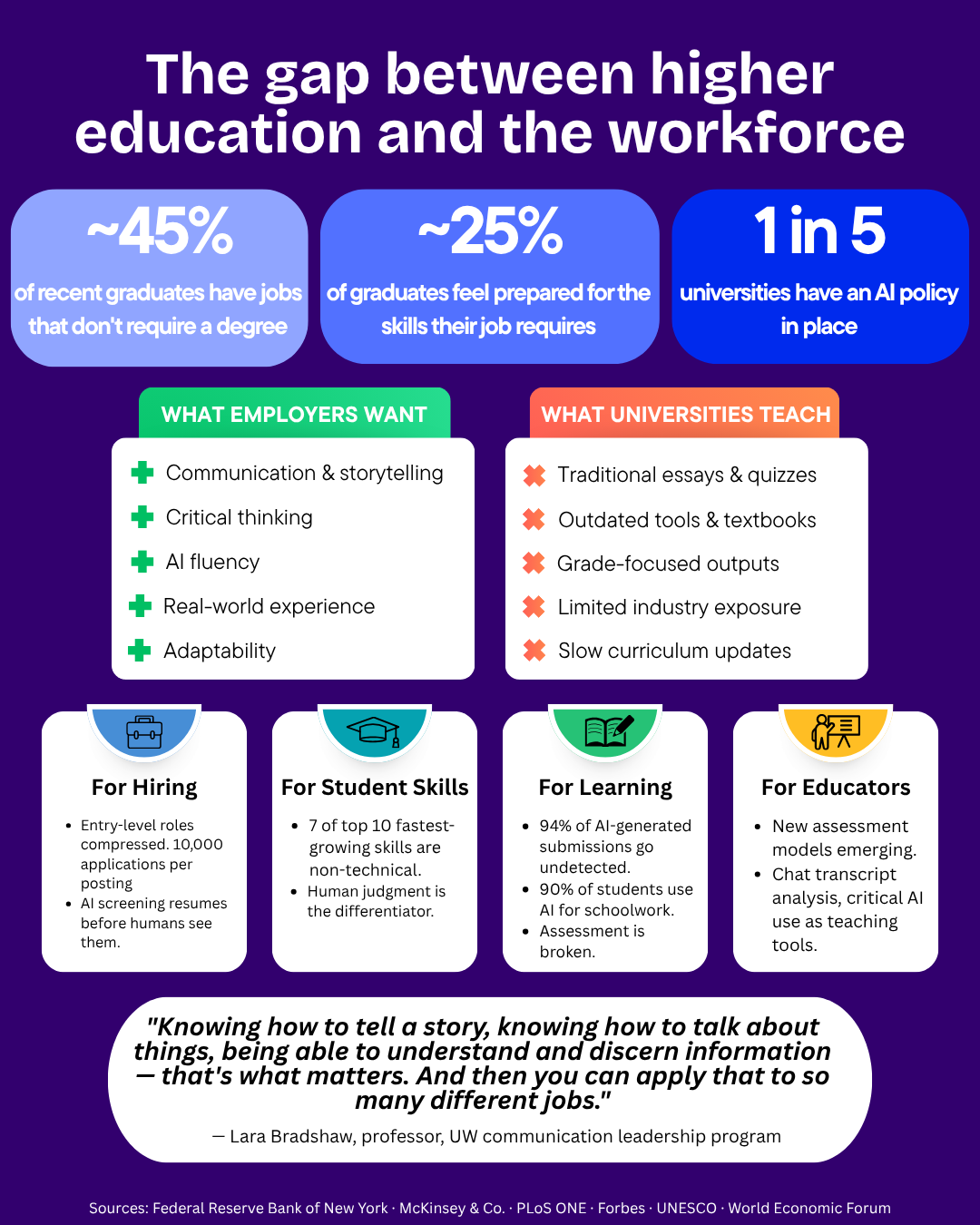
For decades, the cost of a four-year education has been justified by the promise of a higher-paying white-collar job. But as unemployment and underemployment rates among recent graduates reach their highest since 2020, job security feels increasingly uncertain. As AI automates tasks previously handled by junior employees and companies prioritize efficiency, entry-level hiring is hit hardest.
Meta machine learning expert Aditya Gautam describes this as a supply-demand gap: the productivity AI provides allows companies to operate with fewer employees and post fewer jobs.
"Let’s say you have 50,000 analysts out there working on different aspects. Now, there is an agent — from a company perspective, it doesn't make sense to have [50,000] of these analysts. We will have agents working, and we would have 50 analysts supervising them. And these are still senior analysts, not entry-level analysts. So you see how this space is crunching both sides," Gautam said.
At UW’s Career and Internship Center, counselor Sarah Boland said students’ optimism is eroding. "The energy in general is a little low when it has to do with internships and jobs in certain markets and certain industries ... kind of a pre-defeated energy coming into the center," she said.
Part of that attitude, Boland observes, is self-inflicted. Students are using AI to generate application materials entirely, then pasting them across multiple submissions. "The correct way would be using it to find the gaps in the resume or the missing keywords and then doing your own writing, versus copy-pasting one document, which sounds like AI — you can definitely tell."
Universities have long positioned higher education as preparation for the workforce, but generative AI complicates how students are evaluated. In one study, 94% of AI-generated exam submissions went undetected and, on average, earned higher grades than those submitted by students. Surveys suggest about 90% of college students use AI for schoolwork, raising questions about how institutions measure learning.
Mike Kentz, an AI literacy consultant who trains K–12 and higher-education faculty, said AI has "more or less broken" traditional assessment systems by making student thinking invisible.
Kentz has developed an alternative in which students complete assignments within an AI chat window and submit the transcript. "I'm not grading whether the output is good. What I want to see is thinking. I want to see criticality. I want to see you pushing and not accepting passively. And to me, all of those things are the point of education in the first place."
As AI reshapes both the workplace and the classroom, employers are treating AI fluency as a prerequisite for hiring. But if educators don’t enforce modern standards, students are left to navigate them on their own.
UW graduate student and former teacher Spencer Brooks recalls a conversation he had with a veteran teacher whose administrator encouraged faculty to use large language models for lesson plans and emails.
"She used the word insulting," Brooks said. "It was especially insulting because they were totally unusable."
Brooks argues that decisions about AI in the classroom should incorporate teachers. "It's important for there to be, at all levels, the ability to opt out — for a student to say no, for a faculty member to say no — and for there to be multiple stakeholders involved in that conversation."
While one-fifth of universities have an AI policy in place, UW has established guidelines for responsible AI use and published teaching resources for faculty.
Lara Bradshaw, a professor within UW's communication leadership program, redesigned her graduate coursework around AI. Rather than traditional reflection posts, which are easily outsourced to a chatbot, Bradshaw’s students use AI as a conversational partner, assigning it roles like professor or peer, then annotating their transcripts to identify where the AI misrepresented ideas.
Educators and industry experts seem to converge on findings from a McKinsey & Company report highlighting digital literacy, communication, critical thinking, and collaboration as the most durable skills across roles. "Keeping your human voice is really, really critical. AI can support that, but it's never going to replace it. Ever," Bradshaw said.
As demand for non-technical skills grows, human connection becomes the differentiator. But Steven Gustafson, an assistant teaching professor at UW's iSchool and experienced AI systems developer, warns that AI may erode the experiences that build it.
“[Generative] AI systems make it easy to find information where you might have had to go talk to a professor, talk to somebody in industry, get a recommendation or referral,” Gustafson said. “Now you have it instantly, but you've also not made two important connections in your network that you would have left the university with."
For Alvin Le, navigating next steps is straightforward. “Just be informed and adaptable. Know what’s going on in the world, because it’s going to change very quickly.”